

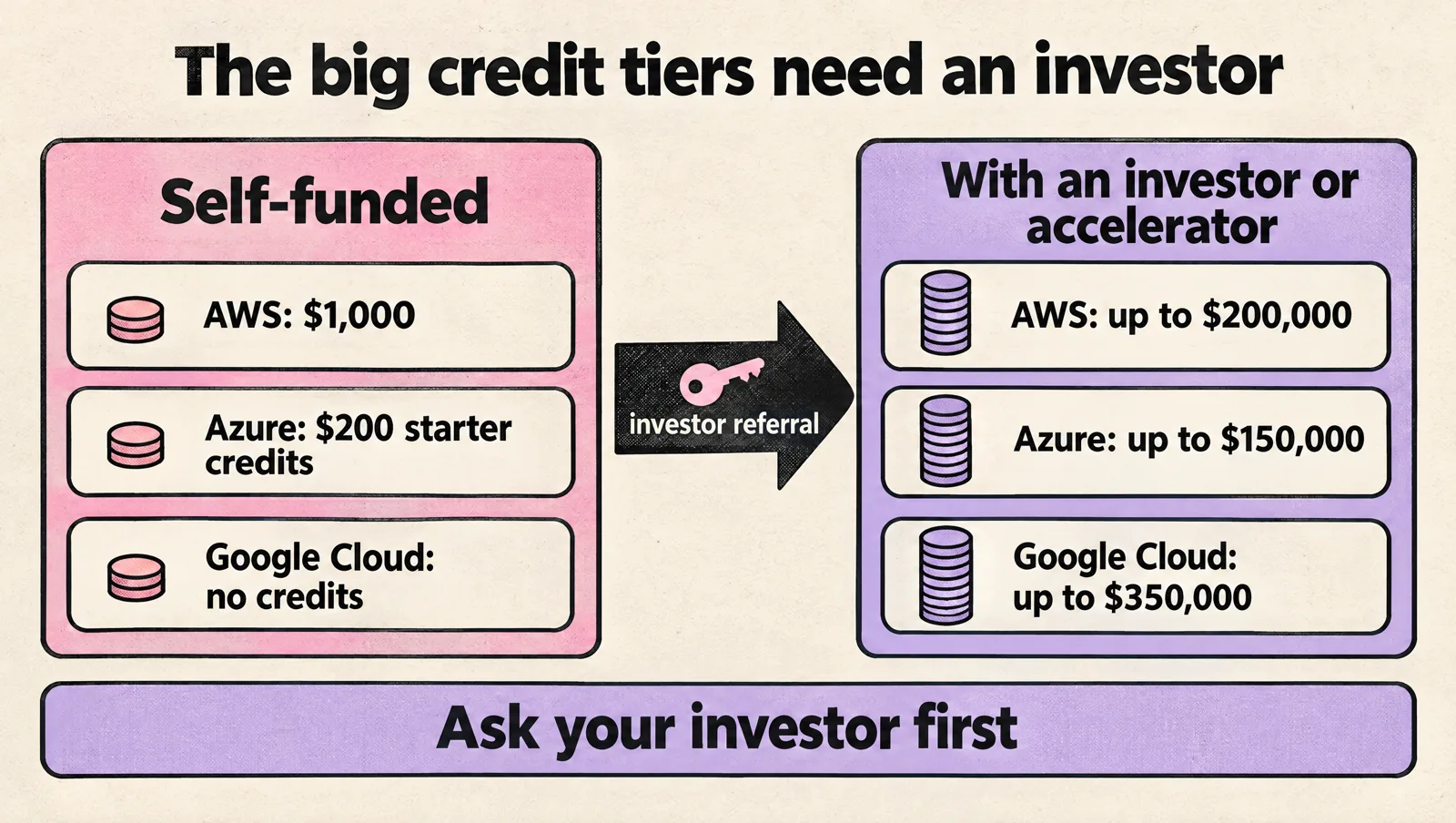
The three big startup cloud credit programs are AWS Activate (up to $200,000), Microsoft for Startups (up to $150,000 in Azure credits) and the Google for Startups Cloud Program (up to $350,000 over two years for AI startups). Self-funded startups can get a few thousand dollars on their own. The six-figure tiers need a backing VC or accelerator. Credits usually expire within one to two years.
This guide compares the programs side by side, explains who qualifies for which tier, and walks through how to apply. It also covers the part most guides skip: how to make credits last, which purchases to avoid while you are on them, and how to plan for the day they run out. Every amount and rule below was checked against the providers' official program pages on October 22, 2026. These programs change often, so confirm the details on the linked page before you apply.
Startup cloud credits compared
| Program | Self-funded / no investor | With an investor or accelerator | Validity | Key eligibility |
|---|---|---|---|---|
| AWS Activate | Founders tier: $1,000, up to $5,000 for select startups | Portfolio tier: up to $200,000 (needs an Activate Provider Org ID) | Usually 1 to 2 years, depending on the package | Pre-Series B, founded in the last 10 years, working website |
| Microsoft for Startups | $200 starter credits, more unlocked over time | $1,000 starter credits, then expanded credits after approval; up to $150,000 in total | Up to 2 years after activation; activate within 90 days | Pre-seed to Series B, B2B software, no more than $350,000 in lifetime free Azure credits |
| Google for Startups Cloud Program | No credits (free Gemini API access in AI Studio for prototypes) | Up to $100,000 in year one plus 20% of spend up to $100,000 in year two; AI startups get up to $250,000 in year one | Two years | Pre-seed to Series A, founded within 3 to 5 years depending on tier, working MVP, no prior Google Cloud credits above $5,000 |
| Cloudflare for Startups | $10,000 (under $1M raised) | $100,000 (under $5M raised) or $350,000 ($5M or more), via an affiliated partner | One year or until used | Incorporated within 10 years, up to Series B within the last 12 months |
| DigitalOcean Hatch | Amount set at onboarding | Amount set at onboarding | 12 months, no extensions | $10M or less raised, new to DigitalOcean credits |
| MongoDB for Startups | Atlas credits (amount not published) | Larger credits by tier (amount not published) | 12 months after activation; extensions case by case | Under 7 years old, Series A or earlier |
| Datadog for Startups | Not available directly | Up to $100,000 for the first year, via a referral partner | First year | Series A or earlier, never a Datadog customer |
Two patterns stand out. First, the large amounts almost always depend on an investor relationship: AWS needs an Activate Provider Organization ID, Microsoft an Investor Network referral code, and Cloudflare and Datadog an affiliated partner. Second, credits are a 12 to 24 month runway, not free infrastructure. The architecture you build on them is the bill you pay afterwards.
AWS Activate
AWS Activate is the most widely used program and has two self-serve tiers plus an invitation-only one.
Tiers and amounts
- Activate Founders: for bootstrapped or self-funded startups. AWS states it "offers $1,000 in AWS Activate Credits", and select startups may qualify for up to $5,000 over time.
- Activate Portfolio: up to $200,000 for startups backed by an Activate Provider (an accelerator, angel group or VC firm in the AWS network). The exact amount varies by funding stage, funding timeframe and provider.
- AWS Credits for AI Startups: $200,000 or more, by invitation only, for AI startups ready to scale beyond Portfolio. Ask your AWS account manager.
Eligibility
- Pre-Series B, and founded within the past 10 years.
- A fully functioning company website.
- An AWS account on the Paid Tier plan.
- New to Activate credits, or requesting more than you received before (you get the difference, up to a lifetime limit).
- For Portfolio: an Organization ID from your Activate Provider, your latest round within the last 12 months, and you must apply within 12 months of your most recent funding date.
How to apply
- Create or sign in to an AWS Builder ID with a professional email and complete your profile.
- Pick the tier. Self-funded startups choose Founders. Backed startups ask their investor or accelerator whether it is an Activate Provider and for its Org ID.
- Answer the questions about your product, funding stage and company.
- Link the AWS account the credits should land in, and submit. AWS says to expect a reply in 5 to 10 business days.
Approved credits and their expiry date appear under Billing and Cost Management > Credits a few hours after approval. Credits apply automatically to eligible charges each month. You cannot point them at specific services, and they do not cover past bills.
What AWS credits do not cover
The AWS Promotional Credit terms exclude, among others:
- Any upfront fee for Savings Plans and Reserved Instances.
- AWS Marketplace purchases.
- Route 53 domain registration and transfer.
- AWS Professional Services, AWS Managed Services, training and certification, and Amazon Mechanical Turk.
- Enterprise-level support plans (Enterprise Support, Enterprise On-Ramp, Unified Operations, resold support).
- Cryptocurrency mining.
The Savings Plans exclusion matters most. A Savings Plan bought while you are on credits is paid partly or fully in cash, and it outlives the credits. More on that below.
Microsoft for Startups (Azure credits)
Microsoft reworked its program in 2026 into a single entry point where credits grow over time. According to Microsoft's application guide (updated October 2026):
- Without an investor referral code: you verify with LinkedIn and get $200 in starter credits immediately. More credits can unlock later based on business verification, service adoption and usage.
- With a 10-character Investor Network referral code: you get $1,000 in starter credits right away, and after approval (typically within three business days) the expanded credits and full benefits package. Microsoft's FAQ says most investor-backed startups begin with $100,000 and can earn more.
- Ceiling: up to $150,000 in Startup credits over time.
Microsoft's own pages are not fully consistent: its FAQ, last revised in May 2026, still describes an offer of $1,000 for 90 days plus $4,000 for 180 days after business verification for startups without an investor. Treat the amounts shown in your own dashboard as the source of truth.
Eligibility
From Microsoft's program overview and application guide:
- A software product or service your company owns; B2B software, AI or technology.
- Privately held and for-profit, not a subsidiary.
- Pre-seed through Series B (no Series C or later).
- Headquartered in a country where Azure is available.
- No more than $350,000 in lifetime free Azure credits.
- Not an educational institution, government organization, consultancy or agency, and not involved in cryptocurrency mining.
Rules that catch people out
- You must sign up with a personal Microsoft account. Work, school and company-domain emails are not accepted, and an account that already has Azure can fail with "Already redeemed".
- Activate your credits within 90 days of accepting the program agreement, or the offer expires.
- Once activated, credits are valid for up to two years, with no extensions.
- Credits are tied to the subscription you create during redemption and cannot be moved to another account. Redeem them on the account and subscription you plan to keep.
- A credit card is required. When credits run out or expire, the subscription converts to pay-as-you-go automatically.
Google for Startups Cloud Program
Google splits the program into two tracks:
- Build your prototype: for bootstrapped and self-funded builders. There are no cloud credits on this track; the benefit is free access to the Gemini API in Google AI Studio.
- Grow and Scale: up to $350,000 in credits over two years.
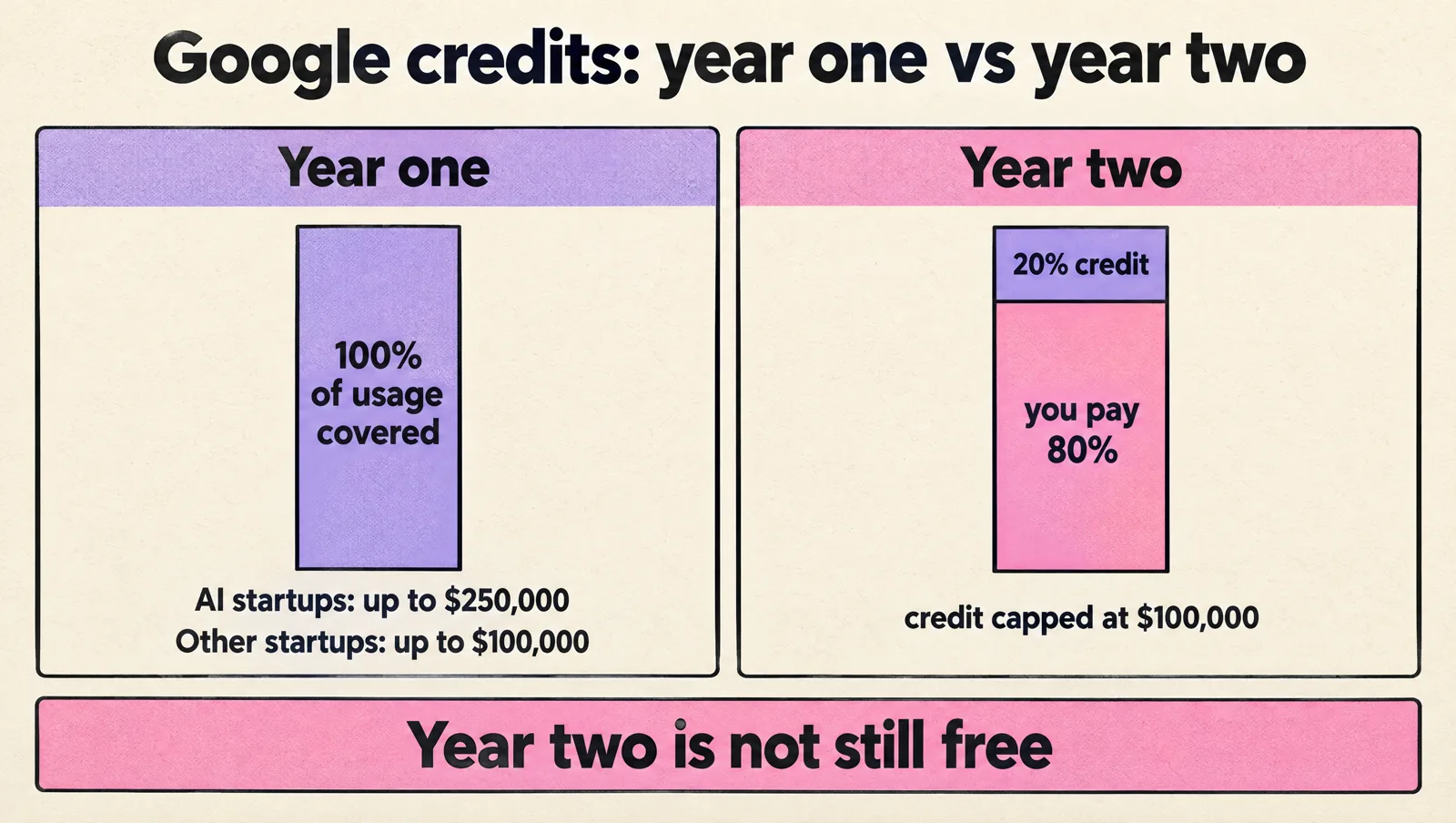
- AI startups: 100% of Google Cloud usage covered up to $250,000 in year one, then a 20% credit on spend up to another $100,000 in year two.
- Other startups: up to $100,000 in year one, then the same 20% credit up to $100,000 in year two.
Eligibility
- Pre-seed to Series A funding.
- Founded within the last three to five years, depending on the tier.
- A digital-native startup with a scalable, proprietary product, a working MVP and a clear roadmap.
- A verified company domain and a company email address that matches your public website.
- No previous Google Cloud credits above $5,000.
- A Google Cloud account and Billing ID to apply.
What Google credits cover
Credits apply to eligible first-party Google Cloud products billed pay-as-you-go. They do not cover subscription, prepaid or annual-license products, third-party products, Google Cloud Marketplace or Model Garden offerings. Google's own models such as Gemini and Gemma are covered; third-party models such as Anthropic's are billed directly and not covered. Accepted startups can also apply separately for 12 months of Google Workspace Business Plus and for Google Maps Platform credits.
Note the year-two structure: a 20% credit means you pay 80% of your bill in year two. Many teams model year two as "still free" and get surprised.
Other credits worth applying for
Cloudflare for Startups
Cloudflare offers $10,000 to bootstrapped startups with under $1M raised, $100,000 to startups with under $5M raised through an affiliated partner, and $350,000 to partner-backed startups with $5M or more. Credits last one year or until used, with no extensions, and upgrading tiers does not reset the clock. They cover the developer platform (Workers, Durable Objects, KV, D1, Queues, Vectorize, R2 up to $10,000, Pages, Images, Stream) and Workers AI with tier caps of $2,500, $10,000 and $50,000. Eligibility: incorporated within 10 years, funded up to Series B within the last 12 months, a live website and a public LinkedIn, X or GitHub presence.
DigitalOcean Hatch
Hatch is for startups that have raised $10M or less and are new to DigitalOcean credits. The credit amount is set in your onboarding email, credits run for 12 months with no extensions, and usage is generally capped at $10,000 a month. GPU products and serverless inference are excluded from core credits. Hatch also includes 15 months of Standard-tier support. Consultancies and agencies are not eligible.
MongoDB for Startups
MongoDB gives Atlas credits in four tiers by funding stage but does not publish amounts. You have 12 months to activate the code and 12 months to use the credits, and you can request an extension case by case if you contact them with three months remaining. Eligibility: under 7 years old, Series A or earlier, a single software product. Existing Atlas users can apply.
Datadog for Startups
Datadog offers up to $100,000 in credits for your first year, only through an official referral partner, and only if you have never been a Datadog customer. You must confirm activation within 30 days of acceptance, and three months of inactivity can remove you from the program. Pick your Datadog region carefully: it cannot be changed later.
How to choose which credits to chase
Credits are a reason to start on a cloud, never a reason to run on two. A practical order of operations:
- Pick your primary cloud on fit, not on credit size. Team skills, the managed services you need, data residency and your customers' clouds matter for years. Credits matter for one or two. If you are weighing platforms, our comparison of EKS, GKE and AKS covers the operational differences.
- Apply to your primary cloud's program at the highest tier you qualify for. If you have an investor, ask them first whether they are an AWS Activate Provider, in Microsoft's Investor Network or a Google partner. That one question is often worth $100,000 or more.
- Add the tools you will actually use. Cloudflare, MongoDB Atlas and Datadog credits are valuable only if those products are in your stack anyway.
- Time the application. AWS Portfolio requires applying within 12 months of your latest round, and most programs start the clock on approval or activation. Apply when you are ready to build, not months before.
Running production across AWS, Azure and Google to burn three sets of credits doubles your operational surface: three IAM models, three networking stacks, three bills. The engineering time usually costs more than the credits are worth.
How to make your credits last
The fastest way to lose credits is to treat them as unlimited. These guardrails take a day to set up and pay for themselves many times over.
1. Set budgets and alerts on day one
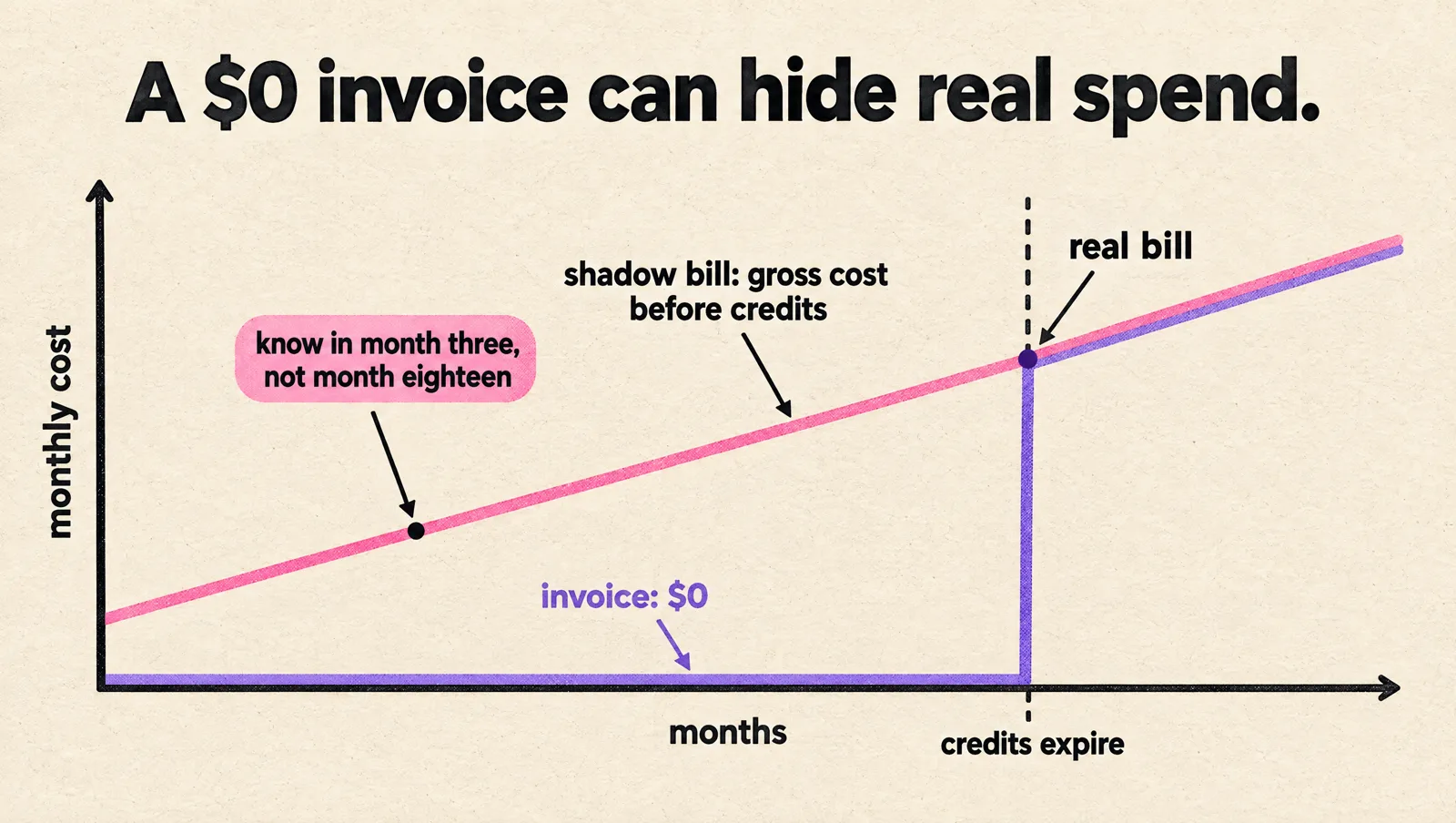
Create a monthly budget with alerts at 50%, 80% and 100% of your expected burn: AWS Budgets, Azure Cost Management budgets or Google Cloud budgets. Track the gross cost before credits, not just the net bill. A $0 invoice can hide a $9,000 monthly burn rate.
2. Keep a shadow bill
Every month, write down what the bill would be without credits and project it forward. When credits expire, that number becomes your real bill overnight. If it is growing faster than revenue, you want to know in month three, not month eighteen.
3. Avoid long commitments while on credits
- AWS credits do not cover upfront fees for Savings Plans or Reserved Instances, so an "all upfront" purchase is paid in cash while you still have credits.
- Google credits do not cover prepaid or annual-license products.
- Any one- or three-year commitment outlives your credits and locks in an architecture you have not proven yet.
Buy commitments when your usage has stabilized and your credits are close to running out, sized to your steady-state baseline.
4. Watch the services credits do not cover
Marketplace software, third-party AI models, enterprise support plans and domain registrations are common sources of surprise charges while the rest of the bill shows $0. Check your invoice line items monthly.
5. Right-size from the start
Habits formed on credits stick. Turn off non-production environments outside working hours, delete idle load balancers and unattached volumes, set log retention, and size containers from real usage. Our guide to Kubernetes requests and limits shows how to size workloads from metrics rather than guesses, and our cloud cost reduction playbook covers the full set of guardrails.
6. Be careful with GPUs
GPU instances can consume a five-figure credit balance in weeks. Some programs exclude GPUs entirely (DigitalOcean's core credits do), and AI-specific credits often come with their own rules. Put GPU workloads on their own budget and shut them down when experiments end.
What happens when your credits run out
Nothing dramatic happens technically, which is exactly the risk. Azure subscriptions convert to pay-as-you-go automatically, and on AWS and Google Cloud charges simply start landing on your card. There is no pause and no warning beyond what you set up yourself.
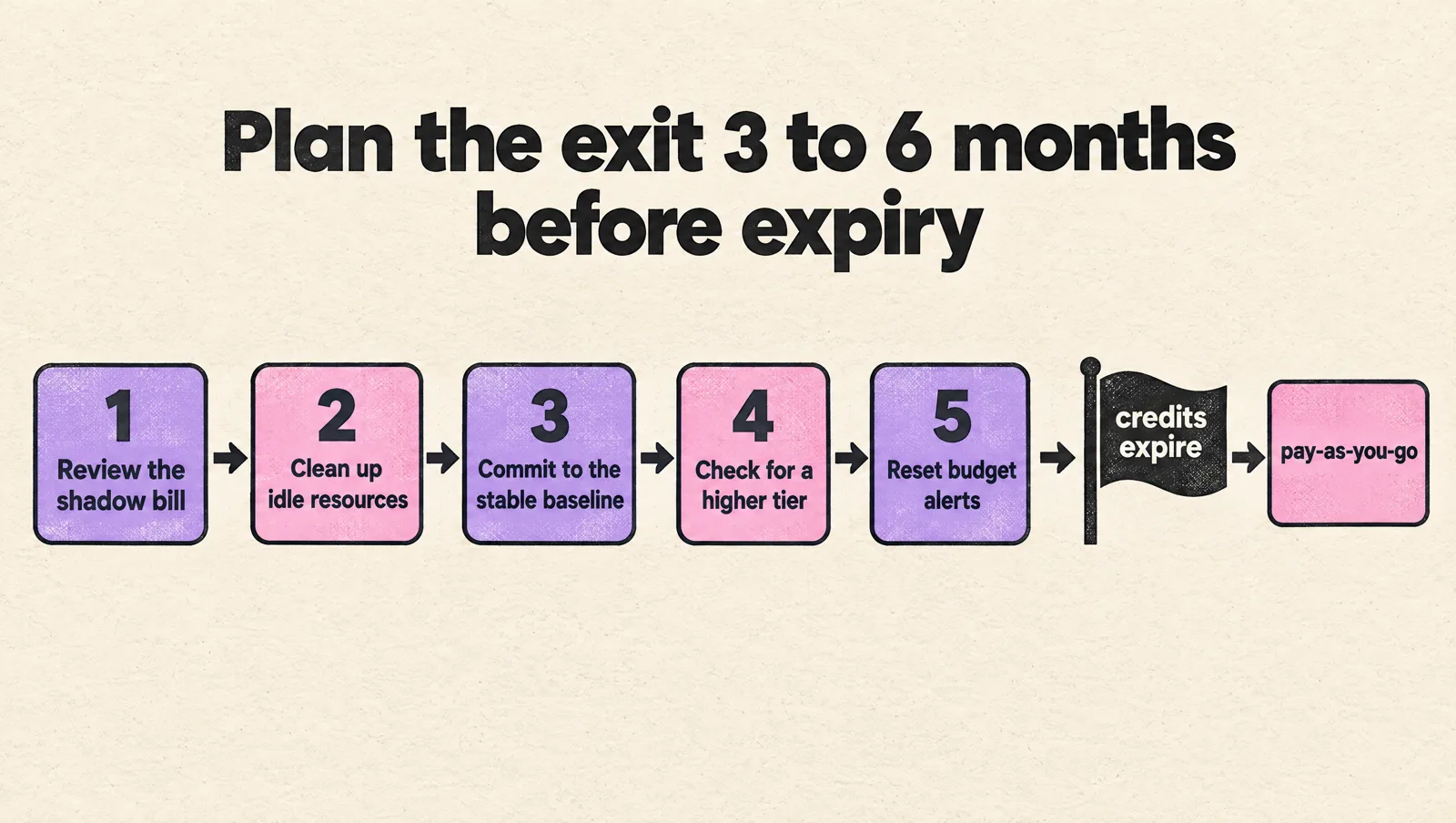
Plan the transition three to six months before expiry:
- Review the shadow bill and identify the top five cost drivers.
- Clean up idle resources and oversized instances.
- Buy Savings Plans or committed use discounts for the stable baseline you now understand.
- Check whether you qualify for a higher tier: AWS lets you reapply for the difference when you move to a higher package, within the lifetime limit.
- Set budget alerts at your expected post-credit spend, not at the old credit-era levels.
If your post-credit bill looks alarming, a focused cost review of a setup that grew on credits usually turns up idle and oversized resources quickly. Our FinOps consulting engineers do exactly this for startups coming off credits.
Common mistakes with startup credits
| Mistake | What happens | Do this instead |
|---|---|---|
| Applying to Founders tier when you have an investor | You get $1,000 instead of up to $200,000 | Ask your investor for an Activate Org ID or Microsoft referral code first |
| Redeeming Azure credits on a throwaway account | Credits are stuck on that subscription for good | Redeem on the account you will keep |
| Applying long before you build | The validity clock runs while you are not using them | Apply when you are ready to deploy |
| Buying upfront Savings Plans on credits | Paid in cash, locked in for years | Commit only to a proven steady-state baseline near credit expiry |
| Ignoring gross cost | The first real invoice is a shock | Keep a monthly shadow bill |
| Going multi-cloud to stack credits | Operational cost exceeds the credits | Pick one primary cloud on fit |
Startup cloud credits FAQ
Does AWS give free credits to startups?
Yes. AWS Activate gives self-funded startups $1,000 through the Founders tier (up to $5,000 for select startups) and up to $200,000 through the Portfolio tier for startups backed by an Activate Provider. You need to be pre-Series B, founded in the last 10 years, with a working website.
How do I get $100,000 in AWS credits?
Through the Activate Portfolio tier. Your accelerator, angel group or VC must be an AWS Activate Provider and give you its Organization ID. The amount depends on your funding stage and provider, and you must apply within 12 months of your most recent funding round.
How much are Azure credits for startups?
Microsoft for Startups offers up to $150,000 in Azure credits over time. Without an investor code you start with $200 in starter credits; with a Microsoft Investor Network referral code you start with $1,000 and, after approval, most startups begin with $100,000. Credits are valid for up to two years after activation.
How much are Google Cloud credits for startups?
Funded startups (pre-seed to Series A) can get up to $100,000 in year one and a 20% credit on spend up to $100,000 in year two. AI startups can get up to $250,000 in year one plus the same year-two credit, for up to $350,000 in total.
Can I get credits from AWS, Azure and Google at the same time?
None of the three program pages prohibits holding credits from another provider, and each checks its own history (for example, Google excludes startups that already received more than $5,000 in Google Cloud credits). The real constraint is operational: running on three clouds to use three credit balances rarely makes sense.
Do startup cloud credits expire?
Yes. AWS credits usually expire within one to two years depending on the package, Azure credits within two years of activation, Google's program runs for two years, and Cloudflare, DigitalOcean and MongoDB credits last about a year. Unused credits are forfeited.
Can consultancies or agencies get startup credits?
Generally no. Microsoft, Cloudflare, DigitalOcean and MongoDB explicitly exclude consultancies, agencies or service businesses. The programs are for companies building their own software product.
Do cloud credits cover AI models?
Partly. AWS lists Amazon Bedrock among the uses for Activate credits. Google credits cover its own models such as Gemini and Gemma but not third-party models like Anthropic's. DigitalOcean's core credits exclude GPU products and serverless inference. Check each program's terms before you plan an AI workload around credits.
Credits buy you time to find product-market fit without a large cloud bill. The startups that benefit most use that time to build a lean, well-tagged, right-sized setup, so the bill after credits is one they planned for. If you want help designing that setup, see how MeteorOps approaches AWS DevOps for startups.