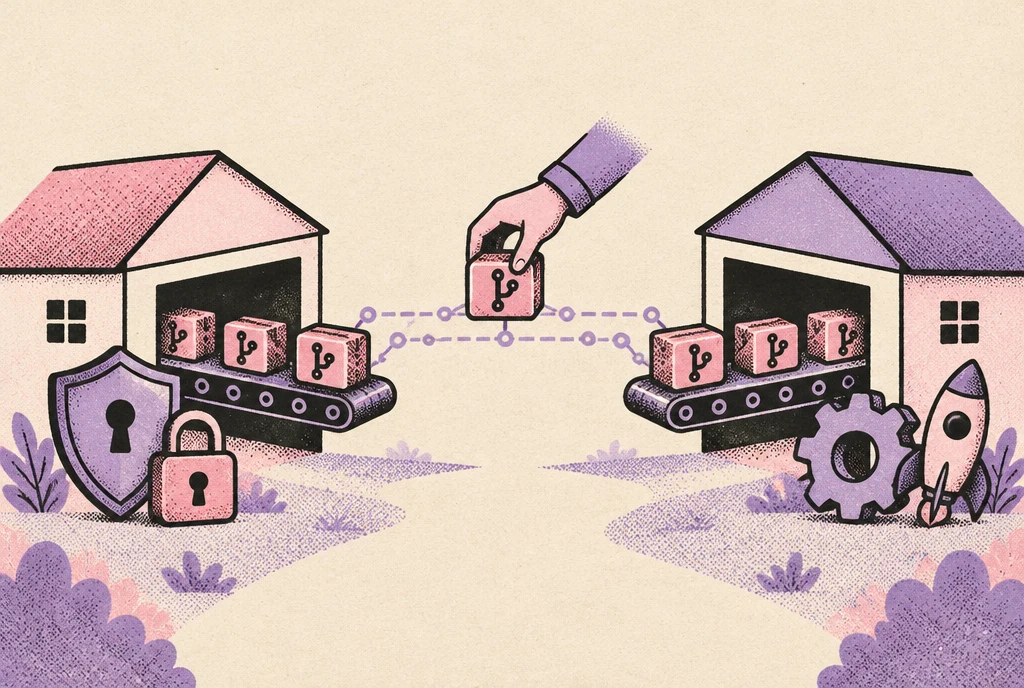


SRE vs DevOps in one paragraph: DevOps is a culture and set of practices for shipping software faster by removing the wall between development and operations. Site reliability engineering (SRE) is a specific, opinionated way to run production that came out of Google: it sets reliability targets (SLOs), spends an error budget against them, and treats operations as a software problem. Google sums it up as "class SRE implements interface DevOps". DevOps optimizes the path to production. SRE optimizes what happens once you are there.
Below is how the two differ in goals, daily work, metrics, skills and pay, how they fit together, and which one a startup actually needs at each stage.
SRE vs DevOps at a glance
| DevOps | SRE | |
|---|---|---|
| What it is | A culture and set of practices across the whole delivery lifecycle | A job role and an engineering discipline for running production |
| Origin | A movement among practitioners at many companies, around 2009 | Google, from 2003, written up in the Site Reliability Engineering book (2016) |
| Main question | How do we ship changes faster and safer? | How reliable must this service be, and are we meeting that? |
| Core practices | CI/CD, infrastructure as code, automation, shared ownership, fast feedback | SLIs and SLOs, error budgets, toil reduction, incident response, blameless postmortems, capacity planning |
| Typical metrics | The five DORA metrics: change lead time, deployment frequency, failed deployment recovery time, change fail rate, deployment rework rate | SLO attainment, error budget burn rate, toil percentage, incident count and duration, pages per shift |
| Prescriptiveness | Principles; little detail on how to run services | Concrete rules, such as caps on toil and on-call time |
| Where the work sits | Pipelines, environments, platforms, developer workflow | Production systems, observability, on-call, reliability of user-facing services |
What DevOps actually means
DevOps started as a reaction to a familiar split: developers were measured on shipping features, operations on keeping things stable, and every release became a fight. DevOps says one team should own the whole path from commit to production, with automation doing the repetitive work.
A common way to describe it is CALMS: Culture, Automation, Lean, Measurement and Sharing. In practice that means CI/CD pipelines, infrastructure as code, small and frequent changes, environments anyone can recreate, and developers who can see and act on how their code behaves in production.
"DevOps engineer" is the job title that grew out of this. In most companies a DevOps engineer builds and runs the delivery platform: cloud infrastructure, CI/CD, containers and Kubernetes, secrets, and the tooling that lets developers ship on their own.
What SRE actually means
SRE is what you get when you ask software engineers to run operations. Its central idea is that 100% reliability is the wrong target. Users cannot tell 99.99% from 100%, and chasing the last fraction slows every release. So SRE makes reliability an explicit, measured number:
- SLI (service level indicator): what you measure, such as the share of requests that succeed in under 300 ms.
- SLO (service level objective): the target for that indicator over a window, such as 99.9% over 30 days.
- Error budget: the failure you are allowed. A 99.9% SLO over 30 days allows about 43 minutes of full downtime, or the equivalent in failed requests.
While budget remains, teams ship freely. When it runs out, the priority shifts to reliability work until the service is healthy again. That one rule turns the old dev vs ops argument into a shared, data-driven decision.
SRE also sets hard limits on operational load. Google's SRE teams aim to keep toil, the manual, repetitive, automatable work that "scales linearly as a service grows", below 50% of each engineer's time. Of the remaining operational time, no more than 25% should be on-call.
How much downtime does each SLO allow?
| SLO | Allowed downtime per 30 days | Per year |
|---|---|---|
| 99% | 7 hours 12 minutes | about 3.65 days |
| 99.5% | 3 hours 36 minutes | about 1.8 days |
| 99.9% | 43.2 minutes | about 8.8 hours |
| 99.95% | 21.6 minutes | about 4.4 hours |
| 99.99% | 4.3 minutes | about 53 minutes |
"class SRE implements interface DevOps"
Google's own SRE workbook frames the relationship this way. DevOps is the interface: a set of principles. SRE is one concrete implementation of those principles, with specific practices for each of them:
- Reduce organizational silos: SREs share ownership of production with developers and use the same tools.
- Accept failure as normal: error budgets and blameless postmortems.
- Implement gradual change: small changes, canary releases, fast rollback.
- Tooling and culture are interrelated: SREs use the same tools as developers, and the toil cap forces automation.
- Measure everything: SLOs and error budgets drive decisions.
The workbook also names the differences: DevOps is broader and targets silos across the whole organization, while SRE is narrower, more prescriptive, and focused on services and their users.
Responsibilities side by side
| Area | DevOps engineer | Site reliability engineer |
|---|---|---|
| CI/CD | Builds and owns pipelines, build caching, release automation | Adds safety: canaries, automated rollback, release gates tied to SLOs |
| Infrastructure | Provisions cloud, networks, clusters with Terraform or similar | Capacity planning, load testing, failure-mode design, disaster recovery drills |
| Observability | Installs and maintains the monitoring and logging stack | Defines SLIs and SLOs, alerting on symptoms and burn rate, dashboards for incidents |
| Incidents | Often on the rotation, fixes infrastructure causes | Leads incident response, runs postmortems, tracks follow-ups to completion |
| Developer experience | Self-service environments, templates, internal platform | Production readiness reviews, reliability guidance for service owners |
| Code | Infrastructure code, scripts, pipeline config | Automation and tooling, sometimes changes to application code for reliability |
In small companies these roles overlap heavily, and one senior engineer often does both. The split becomes real once you have enough services and traffic that reliability needs a dedicated owner.
Skills: where they overlap and where they don't
Shared core: Linux, networking, a major cloud provider, containers and Kubernetes, infrastructure as code, CI/CD, a scripting or programming language, and monitoring.
Leans DevOps: pipeline design, build systems, Terraform module design, developer tooling, platform engineering, cost-aware infrastructure.
Leans SRE: distributed systems failure modes, SLO design, statistics for latency and error rates, performance and capacity analysis, incident command, writing production-grade software in Go, Python or Java.
SRE vs DevOps salary
The two pay similarly, with SRE slightly ahead in most surveys. In the 2024 Stack Overflow Developer Survey, median yearly salaries were:
| Role | United States median | Global median |
|---|---|---|
| SRE | $166,500 | $99,099 |
| DevOps specialist | $145,000 | $72,611 |
| Cloud infrastructure engineer | $165,000 | $96,666 |
The 2025 survey no longer breaks out SRE, but reports a US median of $165,000 for "DevOps engineer or professional". Seniority, location and company size move pay far more than the title does. Treat the gap between the two roles as small.
Which does your startup need?
| Stage | What you need | Why |
|---|---|---|
| Pre-product or MVP, 1 to 10 engineers | DevOps practices, owned by developers, with outside help for the foundation | You need CI/CD, infrastructure as code and basic monitoring. Reliability targets would be guesses. |
| Early customers, 10 to 30 engineers | A first DevOps or platform engineer, plus simple SLOs on your one or two critical user journeys | Delivery speed is the bottleneck. A light SLO keeps reliability from being argued by gut feel. |
| Growth, 30 to 100 engineers | A platform team and your first SRE, or SRE practices embedded in the platform team | Incidents, on-call load and enterprise customers' uptime expectations make reliability a full-time job. |
| Scale, 100+ engineers or strict SLAs | A dedicated SRE function alongside platform engineering | Error budgets, capacity planning and incident management across many teams need clear ownership. |
Two practical rules:
- Hire for the bottleneck. If releases are slow and painful, you need DevOps capability. If releases are fine but outages, pages and customer complaints are the problem, you need SRE capability.
- Don't build a 24/7 rotation too early. Google's guidance puts the minimum for a single-site 24/7 rotation at eight engineers. Most startups get further with business-hours paging, good runbooks and clear severity rules. Our guide to designing an on-call rotation for a small team covers the math.
How DevOps and SRE work together
In a healthy setup, the platform or DevOps team builds the paved road (pipelines, environments, infrastructure modules), and SRE makes sure what runs on that road meets its reliability targets. Concretely:
- Product teams own their services and their SLOs.
- The platform team makes the right thing the easy thing: standard deploys, built-in metrics, safe rollbacks.
- SREs set the SLO framework, review production readiness, lead major incidents and push systemic fixes back into the platform.
- Error budget policy decides, in advance, what happens when a service runs out of budget.
A practical first step for any team is cleaning up alerting so that pages map to user impact. Our article on handling alert fatigue shows how, and the observability stack guide covers what to run at each team size.
Common mistakes
- Renaming the ops team "SRE". Without SLOs, error budgets and a toil cap, it is the same ops team with a new title.
- Hiring a "DevOps engineer" to be the only person who can deploy. That rebuilds the silo DevOps was meant to remove.
- Setting SLOs at 99.99% by default. Each extra nine costs a lot. Start from what users notice and what your dependencies can deliver.
- Measuring only uptime. Latency and correctness matter to users as much as availability.
- Treating it as either/or. Most teams need DevOps practices first and SRE practices as they grow, not one instead of the other.
FAQ
Is SRE better than DevOps?
Neither is better; they solve different problems. DevOps improves how you build and ship software. SRE improves how reliably it runs. SRE is often described as one specific implementation of DevOps principles, so a mature organization usually uses both.
Is DevOps a part of SRE, or SRE a part of DevOps?
SRE is generally seen as an implementation of DevOps. Google's phrase is "class SRE implements interface DevOps": DevOps defines the principles, and SRE is a concrete, prescriptive way to apply them to running production services.
Who earns more, SRE or DevOps?
SREs usually earn slightly more. In the 2024 Stack Overflow Developer Survey, the US median was $166,500 for SREs and $145,000 for DevOps specialists. Seniority, location and employer matter more than the title.
Can a DevOps engineer become an SRE?
Yes, it is one of the most common paths. Add stronger programming skills, learn SLO and error budget design, get comfortable leading incidents and postmortems, and go deeper on distributed systems failure modes and capacity planning.
Will AI replace SRE jobs?
AI tools are taking over parts of the work, such as summarizing incidents, correlating alerts and drafting runbooks and postmortems. The judgment parts remain: choosing reliability targets, deciding trade-offs during incidents and designing systems that fail safely. The role is shifting toward that work, not disappearing.
What is the difference between SRE and platform engineering?
Platform engineering builds the internal products developers use to ship: templates, pipelines, environments, an internal developer platform. SRE focuses on the reliability of the services running in production. Many startups combine them in one team until they grow.
Does a startup need an SRE?
Usually not as a first infrastructure hire. Most startups need DevOps capability first, with simple SLOs on critical user journeys. A dedicated SRE starts to pay off when incidents, on-call load or customer uptime commitments take a meaningful share of engineering time.
The short answer
DevOps gets your changes to production quickly and safely. SRE keeps production as reliable as your users need, and no more. Start with DevOps practices, add SLOs early and cheaply, and bring in dedicated SRE when reliability becomes a job of its own.
Need senior help with either? MeteorOps provides DevOps consulting and SRE and on-call support for startups, from first pipelines to SLOs and incident response.