


To choose a staff augmentation company, judge the engineers, not the sales deck. Insist on interviewing the exact person who will join your team, ask how the vendor screens for your stack, and get clear answers on ramp-up, access, replacement terms, rate structure and how the engagement ends. A good provider answers all of that specifically and in writing before you sign. A weak one talks about its "talent pool", sends a polished CV and asks for a long commitment.
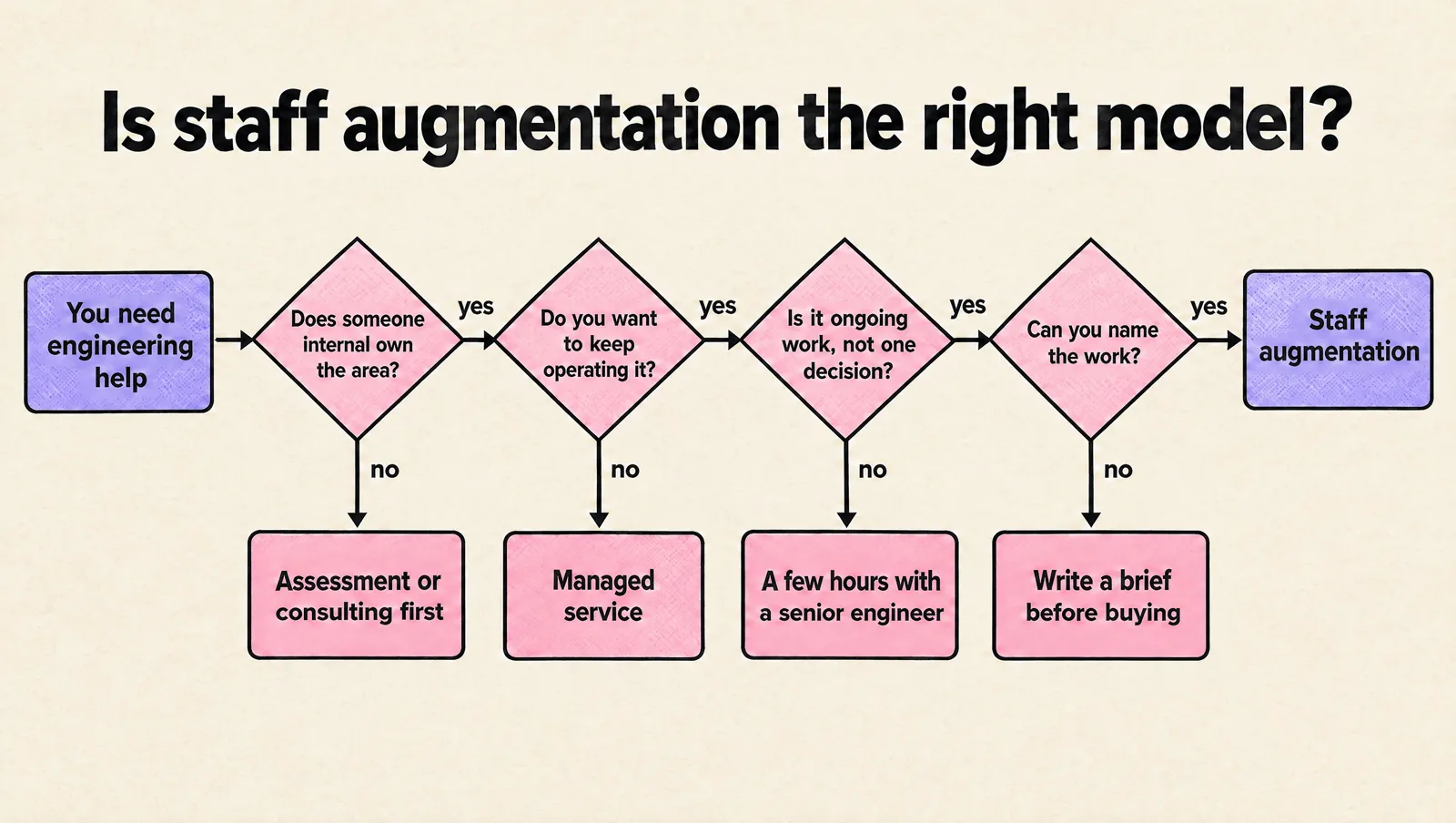
Staff augmentation is the right model when you know what needs doing, you have someone internal who can direct the work, and you are short on senior hands. It is the wrong model when nobody owns the problem: then you need a consultancy or a managed service that takes responsibility for the outcome, not extra capacity that waits for instructions.
This guide is written for CTOs, VPs of Engineering and engineering managers at startups and scale-ups who are buying engineering capacity, with a focus on DevOps, platform and cloud work, where a bad hire can touch production on day three. It covers how staff augmentation compares with managed services and consulting, the questions to ask (with what good and bad answers sound like), how pricing works and how to compare quotes, the contract clauses that matter, red flags, a scorecard, and a first-30-days plan.
What a staff augmentation company actually sells
A staff augmentation company supplies engineers who work inside your team, under your direction, in your tools and your processes. You decide what they work on. They attend your standups, open pull requests in your repositories and follow your review rules. The vendor handles sourcing, employment, payroll, benefits and replacement if the person leaves or is not a fit.
That is the whole product: vetted people plus the commercial wrapper around them. The quality difference between providers comes almost entirely from three things: how good their engineers really are, how honestly they match a person to your problem, and what happens when something goes wrong.
Staff augmentation vs managed services vs consulting
Most buyers searching for a staff augmentation company are also deciding between this model and two others. The difference is who owns the outcome.
| Staff augmentation | Managed services | Consulting / project delivery | |
|---|---|---|---|
| Who directs the work | You | The provider, against an agreed scope or service levels | The provider, against a defined project goal |
| Who owns the outcome | You | The provider | Shared; the provider owns delivery of the agreed scope |
| Typical billing | Hourly or monthly per engineer | Monthly fee tied to service levels | Fixed price or time and materials per project |
| Best for | A known backlog and a gap in senior capacity | Ongoing operations you do not want to run yourself | A specific change you lack the expertise to design |
| Your management effort | High: priorities, reviews, onboarding | Low day to day, high at contract time | Medium: decisions and acceptance |
| Knowledge stays with | Your team, if you insist on documentation | Mostly the provider | Your team, if handover is in the contract |
| Main risk | Paying for capacity nobody directs | Lock-in and slow change requests | A design your team cannot operate after handover |
In practice the lines blur. Many DevOps providers offer an engineer who is embedded in your team and also backed by an architect who reviews their work. That hybrid is often the best fit for a startup without a senior platform lead, because you get capacity plus a second opinion on design decisions. If you want a deeper comparison of provider types, see our breakdown of DevOps agencies, consultancies and services companies.
When staff augmentation is the right call (and when it is not)
Use staff augmentation when most of these are true:
- You can name the work: a Kubernetes upgrade, a Terraform cleanup, CI/CD (continuous integration and continuous delivery) that takes 40 minutes, an observability gap, a cloud migration.
- Someone on your side can set priorities, review pull requests and accept the work, even if only for a few hours a week.
- You need senior skills faster than you can hire. A senior DevOps or platform hire commonly takes months from opening the role to a productive first week.
- The need is real but its long-term size is uncertain, so a permanent headcount is premature.
- You want the knowledge to stay in your team, not in a provider's runbooks.
Choose something else when:
- Nobody internal owns the area. An augmented engineer with no direction drifts toward whatever ticket is loudest. Buy an assessment or a consulting engagement that produces a plan first.
- You want to stop operating something entirely. If the goal is "we never want to think about our database backups again", that is a managed service with service levels, not a person.
- The real problem is organisational. Unclear product priorities, no agreed architecture owner or a team that does not review code will not be fixed by adding people. Extra capacity will expose those problems faster.
- You need one decision, not ongoing work. A few hours with a senior engineer to review an architecture or choose between two approaches is cheaper and faster than a monthly seat.
Pros and cons of staff augmentation
| Pros | Cons |
|---|---|
| Senior capacity in days or weeks instead of months | You still have to manage, onboard and review the work |
| Scale up or down without hiring and layoffs | Higher hourly cost than an equivalent employee's salary |
| Access to specialists you only need for a while (Kubernetes, security, data platforms) | Knowledge leaves with the engineer unless documentation is enforced |
| Full control over priorities and technical direction | Quality varies hugely between providers and between engineers at the same provider |
| The vendor carries recruitment, payroll and replacement risk | Weak vendors rotate people, which resets your onboarding investment |
Write a one-page brief before you contact any vendor
The fastest way to separate good providers from weak ones is to send them all the same short brief and compare what comes back. It also forces you to decide what you are buying. Keep it to one page:
- The problem in one paragraph. "Releases need a senior engineer to babysit them, and our EKS clusters are two minor versions behind" beats "we need a DevOps engineer".
- The stack. Cloud provider, orchestration, IaC (infrastructure as code) tooling, CI/CD system, observability tools, languages of the services being deployed.
- The first three outcomes you would be happy to see in 60 to 90 days.
- Who directs the work on your side and how much time they really have.
- Working pattern. Required time-zone overlap, on-call expectations, meeting cadence.
- Expected volume. A few hours a week, half-time or full-time, and for roughly how long.
- Constraints. Compliance (SOC 2, ISO 27001, HIPAA), data residency, background checks, device policy.
If you are unsure how much DevOps capacity you need in the first place, size it before talking to vendors: our guide to calculating your company's required DevOps capacity walks through the inputs.
Questions to ask a staff augmentation company, and what good answers sound like
These questions are grouped by the risk they test. For each one, the good answer is specific and checkable. The bad answer is vague, deflects to process or promises something nobody can promise.
About the engineers
1. "Can I interview the exact engineer who will work with us?"
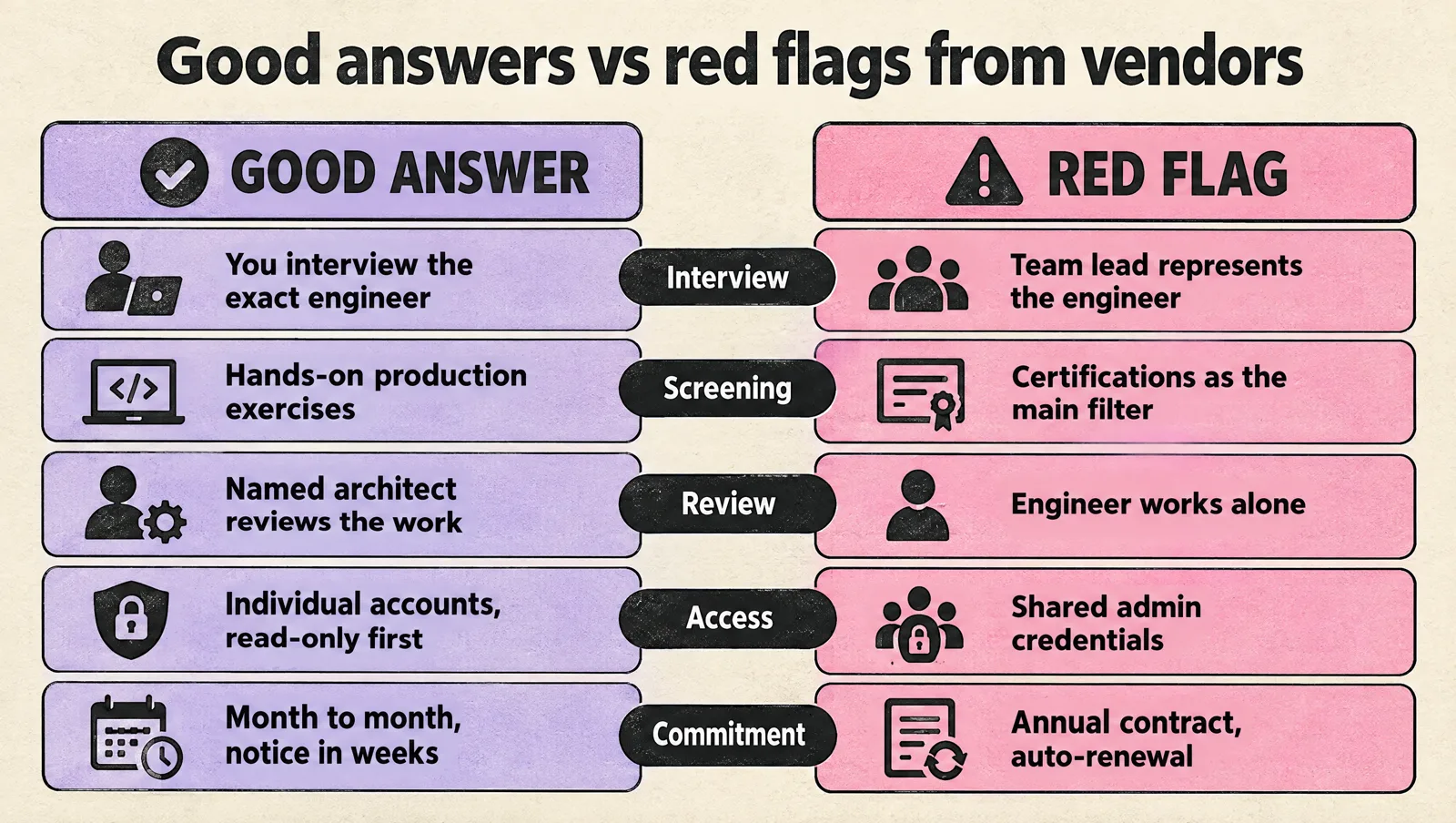
Good answer: yes, before you commit, with a technical conversation led by your own engineer, and the person you interview is the person who starts. Red flag: "our team lead will represent the engineer", "we will assign the best available resource after signing", or a different name on day one.
2. "How do you screen engineers for this specific stack?"
Good answer: a description of a real technical evaluation (hands-on exercises, production debugging scenarios, reviews by senior engineers in that discipline) and how often people fail it. Red flag: certifications and years of experience as the main filter. Certifications show someone passed an exam, not that they can safely upgrade a production cluster.
3. "Is this person an employee or a subcontractor of yours?"
Good answer: a straight answer, either way, plus how they handle confidentiality and IP (intellectual property) assignment for both cases. Red flag: hesitation, or discovering later that your "vendor engineer" was sourced through a second agency, which adds margin and removes accountability.
4. "What has this engineer actually run in production?"
Good answer: concrete examples in their own words during the interview. "I migrated 30 services from ECS (Elastic Container Service) to EKS (Elastic Kubernetes Service) and here is what broke" is worth more than any CV bullet. Ask what they would do differently. Engineers who have operated real systems always have an answer.
About fit and ramp-up
5. "What will the first two weeks look like?"
Good answer: an access plan, a system walkthrough, a review of your repositories and pipelines, and one or two small, low-risk changes shipped in week one. Red flag: "two weeks of discovery" with no output, or the opposite, a plan to rebuild your platform before they have read it.
6. "Who reviews this engineer's work besides us?"
Good answer: a named senior or architect at the provider who is available for design reviews and hard problems, at no extra cost or at a clearly stated one. This matters most when your own team cannot review infrastructure changes in depth. Red flag: the engineer works alone and the vendor's involvement ends at invoicing.
7. "How do you handle time-zone overlap and communication?"
Good answer: a stated number of overlapping working hours, response expectations in your chat tool, and written updates. For DevOps work, a minimum of three to four hours of overlap is a reasonable bar if the engineer touches anything that can page someone. Red flag: "we are flexible" with no numbers.
About security and access
8. "What access will the engineer need, and how do you handle it?"
Good answer: they expect to use your identity provider, your SSO (single sign-on) and individual named accounts, start with read-only or non-production access, and get production access through your normal approval path. They should also mention offboarding: what gets revoked on the last day. Red flag: asking for shared admin credentials or long-lived cloud access keys "to move faster".
9. "What do you require from engineers on security?"
Good answer: device security requirements, a signed NDA (non-disclosure agreement) and IP assignment that flows down to the individual, willingness to follow your policies and complete your security training, and support for background checks if you need them. If you are SOC 2 audited, ask whether they have supported customer audits before.
About commercials and exit
10. "What happens if the engineer is not a fit?"
Good answer: a defined replacement window (for example, a replacement candidate within one to two weeks), no charge for the overlap or ramp-up of the replacement, and a short notice period. Red flag: replacement only after a formal performance process, or a long minimum term with no fit clause.
11. "What is the minimum commitment and notice period?"
Good answer: month to month or a short initial term, with notice measured in weeks. Long lock-ins are a sign the provider is pricing in churn risk. Red flag: annual contracts with auto-renewal for a first engagement.
12. "If we want to hire this engineer, what does it cost?"
Good answer: a clear conversion fee or a period after which conversion is free. Some providers prohibit conversion entirely, which is their right, but you should know before you sign. Red flag: the clause is only discovered when you ask to make an offer.
13. "How will we know this is working?"
Good answer: they propose measures tied to your brief, such as deployment lead time for a named service, manual release steps removed, alert volume, or a migration checklist completed, plus time logs that show where hours went. Red flag: hours logged and tickets closed as the only proof of value.
How staff augmentation pricing works
Almost every staff augmentation company bills by time, but the structure around that time varies a lot. The headline rate is rarely the number that decides what you actually pay.
| Pricing model | How it works | Good for | Watch out for |
|---|---|---|---|
| Hourly, billed monthly | You pay for hours worked, with no minimum or a small one | Uneven or uncertain demand, advisory work | Availability: a part-time engineer may have other clients when you need them |
| Hours bank | You prepay a block of hours and draw it down | A defined project with an uneven pace | Expiry dates on unused hours |
| Monthly capacity | A committed monthly volume (for example, full-time) at a rate tied to that volume | Ongoing embedded work and ownership | Minimum terms and what happens when the engineer is on leave |
| Fixed monthly fee per seat | One price per engineer per month regardless of hours | Predictable budgets | Unclear hours: you may be getting less than full time |
| Cost plus markup | The engineer's cost plus a disclosed margin | Large, long engagements where transparency matters | Rare in practice; verify what "cost" includes |
How to compare quotes from different providers
Rates for DevOps and platform engineers vary several times over between regions, seniority levels and provider types, so comparing headline numbers tells you little. Compare the cost of useful, senior output instead:
- Seniority you actually get. A cheaper engineer who needs a week to do what a senior does in a day is more expensive. Ask what the engineer has done before, not what level they are labelled.
- Ramp-up cost. Who pays for the first week of onboarding, and for the ramp-up of a replacement?
- Included support. Is architect review, specialist backup or holiday cover included or billed separately?
- Minimums and lock-in. A lower rate with a six-month minimum can cost more than a higher rate you can stop after a month.
- Your management time. A provider that needs you to write detailed tickets for every task consumes your most expensive hours.
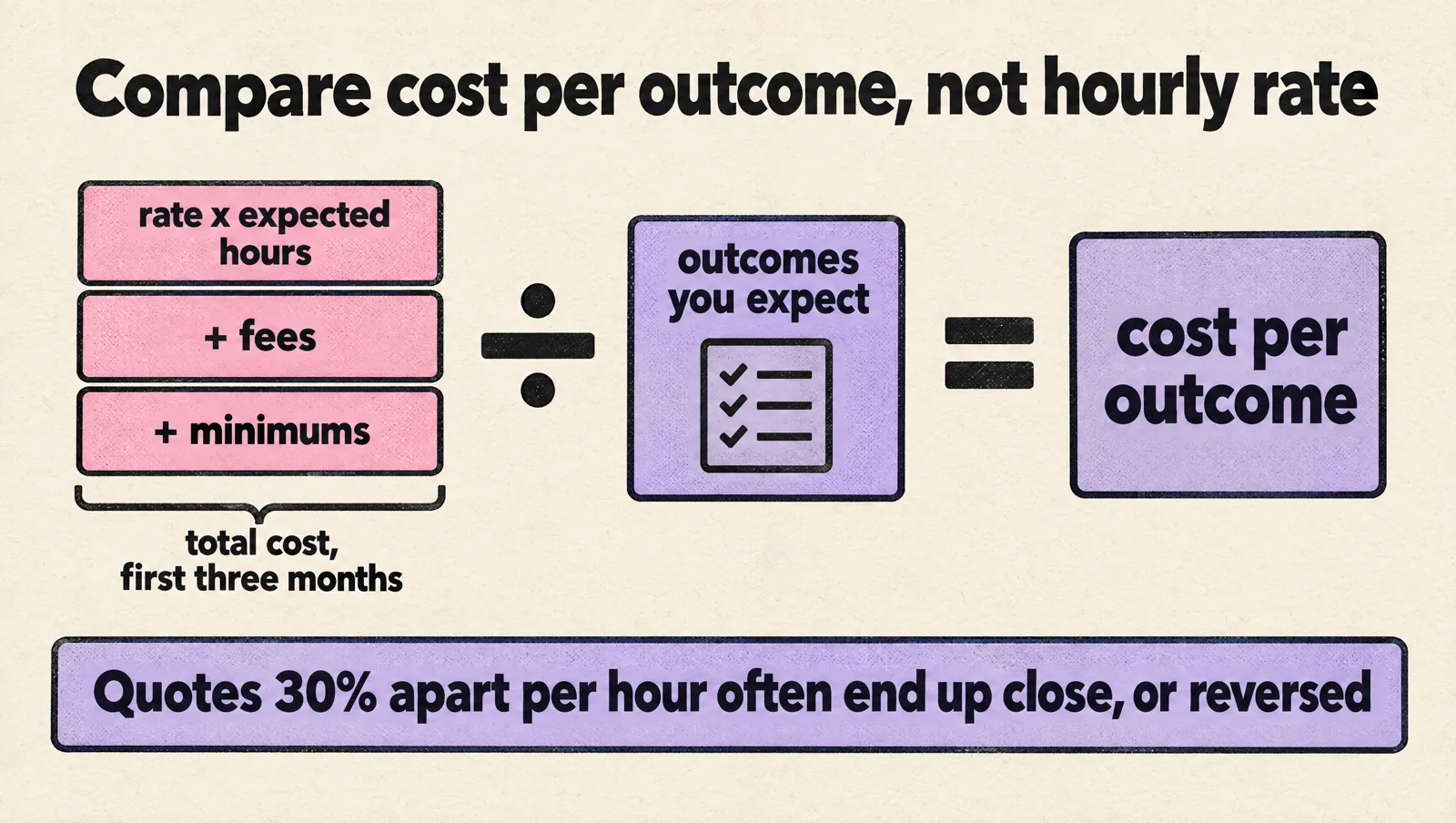
A simple way to compare: estimate the total cost of the first three months (rate times expected hours, plus any fees and minimums), then divide it by the outcomes you expect in that period. Two quotes that differ by 30% per hour often end up close, or reversed, on that measure.
Also compare against hiring. An employee's salary is not their full cost: benefits, payroll taxes, equipment, recruiting fees and management time add a substantial amount on top, and an open senior role costs you months of the work not being done. Augmentation usually costs more per hour than an employee, and less than an empty seat.
Contract clauses to check before you sign
| Clause | What you want |
|---|---|
| Named engineer | The engineer you interviewed is named, and substitution requires your approval |
| IP assignment | All work product belongs to you, and the assignment flows down to individual engineers and any subcontractors |
| Confidentiality | An NDA that covers the vendor and each individual, with a defined survival period |
| Replacement | A replacement timeline and no charge for the replacement's ramp-up |
| Term and notice | Short initial term, notice in weeks, no silent auto-renewal into a long term |
| Rate changes | Rates fixed for a stated period, with notice before any increase |
| Conversion | A stated fee or free conversion after a period, if you may want to hire |
| Non-solicitation | Reasonable scope and duration, mutual, and not blocking conversion you have paid for |
| Security and compliance | Your policies apply, access is individual and revocable, and the vendor supports audits |
| Offboarding | Handover of documentation and credentials, and access revoked on the last day |
| Liability and insurance | Professional liability coverage appropriate for engineers who touch production |
None of these are exotic. A provider that resists most of them is telling you how it expects the relationship to go.
Red flags that should end the conversation
- You cannot interview the engineer. This is the single most reliable warning sign.
- Bait and switch. A strong engineer in the interview and a different, weaker one on day one.
- "We have someone for every technology." Breadth claims with no depth behind them usually mean the vendor matches keywords on CVs.
- No questions about your system. A provider that quotes before asking about your stack, team and constraints is selling hours, not outcomes.
- Pressure toward a long commitment before any work has been delivered.
- Requests for shared or permanent admin access. Good engineers ask for the least access they need.
- Vague answers about subcontracting or about who actually employs the person.
- No references from similar companies, or references they will not let you speak to.
A scorecard to compare staff augmentation companies
Score each provider from 1 to 5 on each criterion after the interviews, multiply by the weight and add up. Adjust the weights to your situation; these suit a startup buying senior DevOps capacity.
| Criterion | Weight | What a 5 looks like |
|---|---|---|
| Engineer's technical depth (from your own interview) | 30% | Has run your stack in production and explains tradeoffs clearly |
| Fit with your problem and team | 15% | Asked good questions about your brief and proposed sensible first steps |
| Senior backup and review | 15% | Named architect or senior available for design reviews |
| Communication and overlap | 10% | Clear overlap hours, written updates, fast responses during evaluation |
| Security practices | 10% | Individual access, least privilege, clean offboarding, audit support |
| Commercial flexibility | 10% | Short notice, fit clause, transparent rates, clear conversion terms |
| References | 10% | Similar companies who confirm the engineers' quality, not just the sales experience |
The engineer's interview carries the most weight on purpose. A great provider with the wrong person for your problem is still the wrong choice.
The first 30 days with an augmented engineer
Most failed engagements fail in the first month, usually because access was slow, priorities were unclear or nobody reviewed the work. A simple plan prevents all three.
- Before day one: accounts in your identity provider, repository access, chat channels, read-only cloud and cluster access, and a short list of documents and dashboards to read. Name the internal owner who sets priorities.
- Week 1: system walkthrough with someone who knows the history, review of infrastructure code and pipelines, and one or two small changes shipped through your normal review path. Ask for a written list of the top risks they noticed.
- Week 2: the first meaningful item from your brief, such as removing a manual release step, tuning noisy alerts or fixing a flaky pipeline stage. Production access granted through your normal approval process if the work needs it.
- Week 3: a larger piece of work with a written plan and rollback path, reviewed by your owner and, ideally, the provider's architect.
- Week 4: a review meeting. Compare progress with the brief, read the time logs, agree on the next month's priorities and decide whether to continue, change scope or stop.
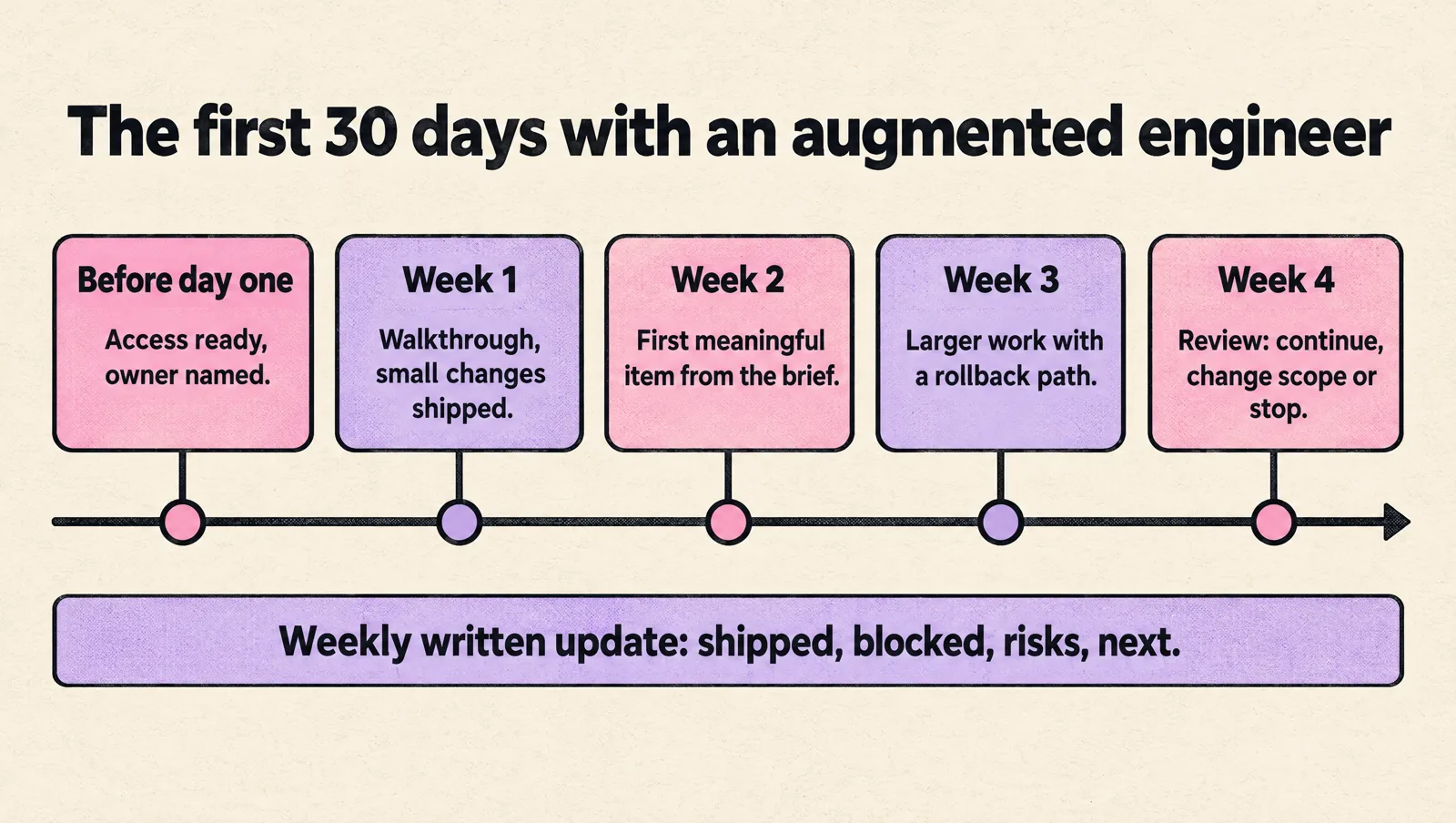
Keep a weekly written update: what shipped, what is blocked, what risks appeared and what is next. It takes the engineer fifteen minutes and gives leadership what it needs without extra meetings.
How to measure whether staff augmentation is paying off
Measure outcomes your team would care about even without a vendor. For DevOps and platform work, the DORA metrics are a good backbone: deployment frequency, change lead time, change fail rate, failed deployment recovery time and rework rate. Add measures specific to your brief:
- Manual steps removed from the release process.
- Share of infrastructure changes made through reviewed IaC rather than the console.
- Pages per week and the share that needed action.
- Time for a new developer to get a working environment.
- Migration or upgrade checklist items completed.
- Documentation produced: runbooks, architecture decision records and README updates your team actually uses.
Avoid measuring hours, tickets closed or meetings attended. They show activity, not whether your systems became safer or faster to change.
Notes specific to DevOps and platform staff augmentation
DevOps work carries more risk than most augmented roles, because the engineer works on the systems everything else depends on. A few extra checks are worth it:
- Infrastructure changes go through code review. Terraform plans, Helm changes and pipeline edits should be reviewed pull requests, never console changes, from the first week.
- On-call is explicit. Decide whether the engineer joins your rotation, what the response expectations are, and how it is billed. Do not let it happen by accident after the first incident.
- Bus factor is tracked. If only the augmented engineer understands the new deployment pipeline, you have built a dependency on a vendor. Pair them with an internal engineer on anything critical.
- Breadth matters. DevOps covers Kubernetes, cloud networking, IAM (identity and access management), CI/CD, observability and cost. One engineer will not be deep in all of it, which is why access to specialist backup at the provider is valuable. If you are still defining the role, read how to build a DevOps team.
FAQ
What is a staff augmentation company?
A staff augmentation company provides engineers who join your team temporarily and work under your direction. The provider employs or contracts the engineers and handles sourcing, payroll and replacement, while you set priorities and own the outcome.
What is the difference between staff augmentation and managed services?
With staff augmentation you direct the work and own the result; the provider supplies people. With managed services the provider owns an agreed outcome or service level and decides how to deliver it. Augmentation gives you control and keeps knowledge in-house; managed services reduce your management effort at the cost of control.
How much does staff augmentation cost?
Most providers bill hourly or per month per engineer, and rates vary several times over with seniority, specialism and region. Compare total cost against expected outcomes over the first few months, including minimums, ramp-up and included support, rather than headline hourly rates.
Is staff augmentation better than hiring a full-time engineer?
It is better when you need senior skills quickly, the long-term need is uncertain, or the work is specialised and temporary. Hiring is better when the need is permanent and central to your product. Many companies use augmentation to cover the gap while they hire, and some convert the augmented engineer.
How long does it take to onboard an augmented engineer?
A senior engineer with good access and a clear brief should ship small changes in the first week and meaningful work by the second. If it takes longer, the cause is usually slow access approvals or unclear priorities on the client side.
What should a staff augmentation contract include?
At minimum: the named engineer, IP assignment that flows down to individuals, confidentiality, replacement terms, term and notice period, rate change rules, conversion terms, security obligations and offboarding. Short terms and clear exit clauses protect both sides on a first engagement.
What are the risks of staff augmentation?
The main risks are paying for capacity nobody directs, knowledge leaving with the engineer, vendor rotation of people, and over-broad access on critical systems. Each one is managed by an internal owner, enforced documentation, a named-engineer clause and least-privilege access.
The short version
Pick a staff augmentation company by the engineer you will actually get, not by the company's pitch. Write a one-page brief, send the same brief to each provider, interview the exact person, check the contract for replacement, notice and IP terms, and run the first month against a written plan. If the answers are specific and the first weeks produce visible work, the model works. If they are vague, keep looking, or reconsider whether you need capacity or someone to own the problem.
If you are looking for senior DevOps, SRE or platform engineers who work inside your team with an architect behind them, see how our DevOps staff augmentation works, or compare buying options.