
DevOps tooling rarely begins from a clean architecture diagram. It usually accumulates under pressure: releases pile up behind manual gates, production changes feel like bets, secrets drift between CI variables and cloud consoles, and ownership of the delivery path is fuzzy. In a young or fast-scaling team, the reflex is to add another dashboard, plugin, workflow, or managed service. A leaner response is to pause long enough to map the handoffs, bottlenecks, and failure modes the stack must actually handle before adding more moving parts.
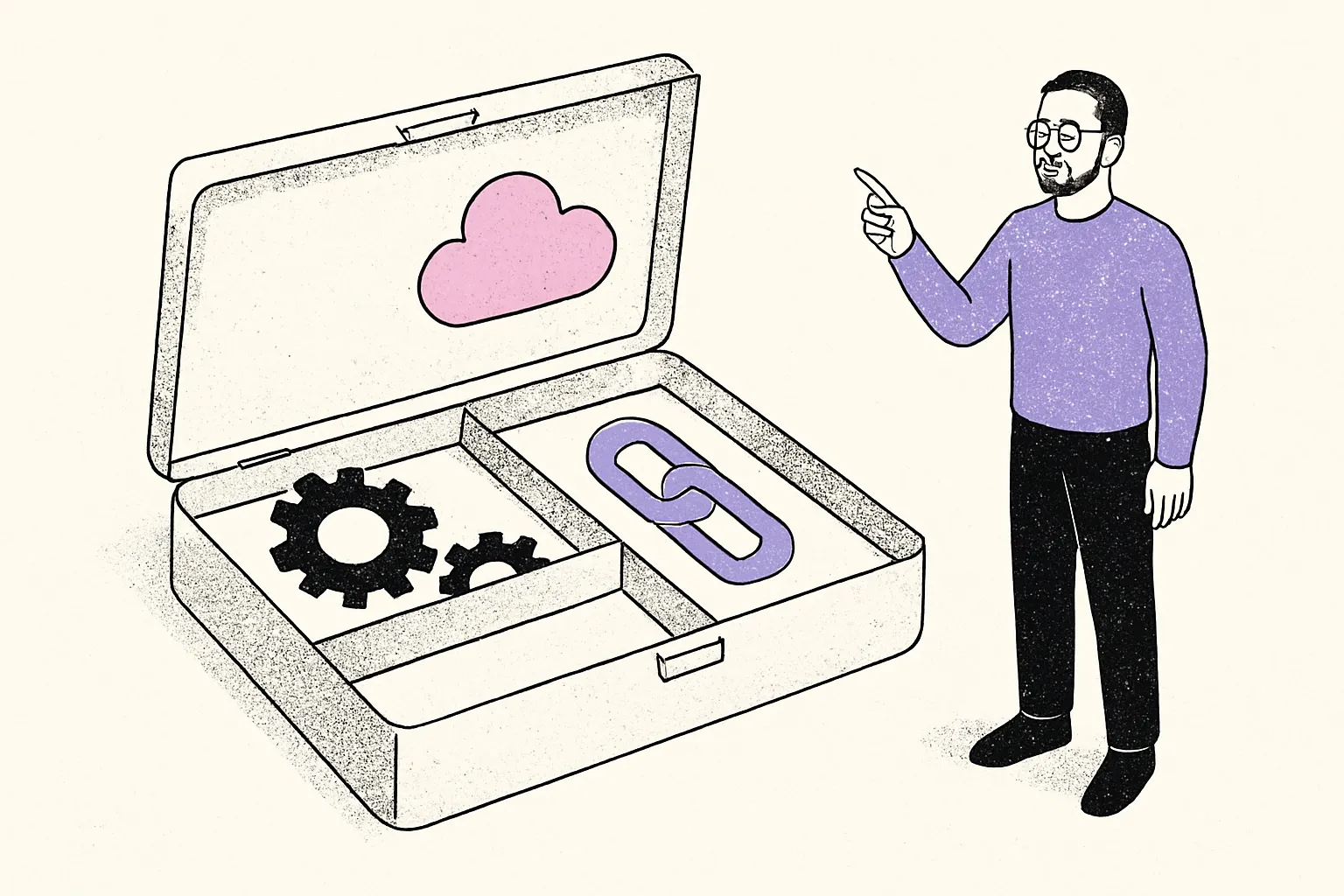
A lean DevOps stack takes the opposite approach: it uses the smallest set of well-integrated tools that can support safe deployments, repeatable infrastructure changes, useful incident visibility, controlled secrets, and fast onboarding. Lean does not mean cheap, bare-bones, or anti-tooling. It means each tool has a clear owner, a clear job, and a clear reason to exist in the delivery system. If a tool introduces another approval path, identity model, policy language, billing surface, or place to debug failed releases, it needs to justify that operational cost.
Start with the work the stack must support
Before choosing tools, define the work your DevOps stack needs to support over the next 12 to 18 months, not the platform you might want someday. A seed-stage team shipping one backend service may need a reliable CI/CD path, basic observability, managed secrets, and reproducible infrastructure. A Series B company may also need multiple environments, background workers, data pipelines, compliance evidence, stronger access controls, and customer-specific infrastructure. The mistake is buying for the imagined future while today’s release process still depends on tribal knowledge, Slack approvals, and one engineer who knows which console setting matters. If the current state is unclear, use a lightweight DevOps maturity assessment to separate real delivery and reliability gaps from a wishlist of tools.
For most growing engineering teams, the essential jobs are not exotic. They fit into a small set of categories that should drive tool selection before anyone compares feature matrices, launches another proof of concept, or signs up for a platform that solves problems the team does not yet have. Start by naming the job, the owner, the failure you are trying to prevent, and the point at which the current approach will stop scaling.
- Provision infrastructure consistently: Environments should be created, reviewed, and changed through Infrastructure as Code, or IaC, rather than one-off console edits. This applies to more than compute: clusters, databases, IAM policies, DNS records, networking rules, queues, observability resources, and scheduled jobs should be reproducible from versioned configuration where practical. The common failure mode is not dramatic; it is drift. Someone changes a staging database setting by hand, production is assumed to match it, and the next deployment behaves differently in each environment. The practical test is simple: a new environment should be rebuildable from code, peer review, and documented variables without relying on someone’s memory of a console checkbox.
- Deploy application changes safely: Continuous integration and continuous delivery, or CI/CD, should build, test, and release code with clear controls.
- Control secrets and access: Credentials should not live in Git, local laptops, shared documents, or undocumented CI variables.
- Observe production behavior: Engineers should be able to see logs, metrics, traces, errors, and alerts during an incident.
- Support local and onboarding workflows: A new engineer should know how to run the app, deploy a change, and request access without asking five people.
If a tool does not clearly support one of these jobs, it probably does not belong in your first version of the stack. For a structured approach to selection, this guide on choosing the right DevOps tools for your team covers the tradeoffs in more detail.
Keep the stack small and boring where possible
A lean DevOps stack is not the cheapest stack or the smallest number of tools. It is the stack your team can understand, operate, and extend without creating hidden risk.
A practical baseline usually includes:
- Cloud provider: AWS, Google Cloud, Azure, or another primary platform. Pick one default unless you have a strong reason to run multiple clouds.
- Infrastructure as Code: Terraform, OpenTofu, Pulumi, or native cloud templates. The key requirement is repeatability and reviewable change history.
- CI/CD platform: GitHub Actions, GitLab CI, CircleCI, Buildkite, Azure DevOps, or similar. Use one main path for builds and deployments.
- Runtime platform: A managed Platform as a Service, containers on a managed service, virtual machines, or Kubernetes when the complexity is justified.
- Secrets management: A managed secrets service, vault-based system, or cloud-native secret manager with clear access boundaries.
- Observability: Logs, metrics, alerts, and ideally traces. Start with enough coverage to debug real incidents.
- Incident and ownership workflow: On-call routing, runbooks, escalation paths, and ownership for each production service.
The biggest mistake is buying or adopting for a future operating model you do not have yet. Enterprise incident tooling will not fix unclear ownership. Kubernetes will not fix weak deployment discipline. A premium observability platform will not help much if your services emit poor logs and no useful metrics.
Be careful with Kubernetes by default
Kubernetes can be the right choice, especially when you need strong workload portability, complex orchestration, custom controllers, or a shared platform for many services. It can also become the most expensive operational decision in your stack if your team is not ready to own it.
Before adopting Kubernetes, ask:
- Do you have enough services or deployment complexity to justify it?
- Who owns cluster upgrades, networking, ingress, autoscaling, security policies, and cost controls?
- Can engineers debug failed pods, resource limits, and service discovery issues without waiting for one specialist?
- Will Kubernetes reduce operational risk, or will it move that risk into a layer fewer people understand?
For many teams moving off Heroku, Render, Railway, or Fly, a managed container service may be a better next step than a full Kubernetes platform. You can still get repeatable deployments, environment control, and cloud-native networking without taking on every Kubernetes concern on day one.
A useful rule: adopt Kubernetes only when you can name the operational problems it solves for your team right now—such as scheduling many services, standardizing runtime environments, or improving rollout control—not because it looks like the default shape of “serious” infrastructure.
Design CI/CD around safety, not convenience
CI/CD is often where a lean stack succeeds or fails. A fast pipeline that nobody trusts will get bypassed. A complex pipeline that only one engineer understands will become a bottleneck.
Your pipeline should answer four questions clearly:
- What code is being built? Use commit SHAs, tagged releases, and reproducible build steps.
- What checks must pass? Include tests, linting, security checks where appropriate, and infrastructure plan reviews.
- Who can deploy where? Separate permissions for development, staging, and production.
- How do you roll back? Document rollback steps and test them before a production incident.
Undocumented CI/CD permissions are a common failure mode. A startup may begin with every engineer able to deploy production because it is faster. Six months later, nobody knows which tokens exist, which GitHub environments map to production, or which cloud role the deployment runner uses.
At minimum, document:
- Which branches or tags can trigger deployments
- Which users or teams can approve production releases
- Which cloud roles the CI/CD system assumes
- Where deployment secrets live
- How emergency fixes are handled
This does not need to be heavy. A simple repository file named DEPLOYMENT.md with the current rules is much better than tribal knowledge.
Use a sample toolchain as a reference, not a template
There is no universal DevOps stack. Still, a simple reference can help you reason about what belongs in your setup.
Example lean stack for an early growth team
- Source control: GitHub or GitLab
- CI/CD: GitHub Actions or GitLab CI
- Infrastructure as Code: Terraform or OpenTofu
- Runtime: Managed containers, managed virtual machines, or Kubernetes only if clearly needed
- Secrets: Cloud-native secret manager or a dedicated secrets platform
- Observability: Centralized logs, metrics, alerts, and error tracking
- Documentation: Repository-level runbooks, onboarding notes, and deployment guides
This stack is intentionally plain. The goal is to make common operations predictable:
- A developer opens a pull request that includes app and infrastructure changes.
- The CI/CD system runs tests and shows an infrastructure plan before merge.
- A staging deployment happens automatically or through a clear approval step.
- Production requires an explicit approval from the right group.
- Logs, metrics, and alerts point engineers toward the failing service during an incident.
If your current setup cannot support this flow, you do not necessarily need more tools. You may need fewer paths, clearer ownership, and better documentation.
Avoid the common traps
Most DevOps stack problems come from decisions that made sense in isolation. The trouble appears when nobody curates the whole system.
- Buying enterprise platforms too early: Large platforms often assume mature processes, dedicated owners, and time for configuration. If your team still lacks basic deployment discipline, start there.
- Adopting Kubernetes by default: Kubernetes adds operational surface area. Use it when its benefits outweigh the ownership cost.
- Tool sprawl: Multiple CI systems, multiple observability platforms, and scattered secret stores create confusion during incidents.
- No ownership model: Every production service should have a clear owner, even if ownership is a small team rather than an individual.
- Weak observability: Logs alone are rarely enough. You need signals that explain health, latency, errors, saturation, and user impact.
- Undocumented access: Cloud roles, CI tokens, deploy keys, and production approvals should be visible and reviewable.
If ownership is unclear because your team structure is still forming, this article on how to build a DevOps team can help you decide what should sit with product engineers, platform engineers, or outside support.
Build the stack in the right order
Do not start by comparing every tool category. Start by reducing operational risk in the order your team feels it.
- Map the current deployment path: Follow one representative change from merge to production and document every gate it passes through: CI jobs, artifact creation, approvals, scripts, manual handoffs, feature-flag flips, environment or secret changes, database migration steps, smoke tests, observability checks, rollback actions, and the “tribal knowledge” still buried in Slack threads, runbooks, or individual engineers’ heads.
- Identify fragile points: Look for laptop-only steps, shared credentials, manual cloud console changes, and unclear rollback paths.
- Standardize infrastructure changes: Move cloud resources into IaC and require review before production changes.
- Clean up CI/CD permissions: Remove unused tokens, document deploy roles, and separate staging from production access.
- Improve observability around critical flows: Start with the services that affect signups, payments, core API requests, background jobs, or customer-facing workflows.
- Write the operating docs: Keep runbooks short. Include deploy steps, rollback steps, alert meanings, and escalation paths.
If you are unsure where the biggest risks sit, a focused DevOps audit can give you a practical map of what to fix first. If you need a fast outside review of your production readiness, you can also request a DevOps setup for production consultation.
Takeaway
A lean DevOps tools stack should make production safer without creating a platform your team cannot operate. Choose tools only after you understand your deployment flow, infrastructure ownership, secrets model, and observability gaps.
Your goal is simple: developers can deploy safely, infrastructure changes are repeatable, incidents are visible, secrets are controlled, onboarding is clear, and the stack can support the next 12 to 18 months of growth. If a tool helps that goal and has a clear owner, consider it. If it adds another path, another permission model, or another place to debug without reducing real risk, leave it out for now.